Everyone is talking about AI. This is the room that takes prompts to production.
A six-month room of eight to twelve operators already using AI to do the work of a team they can’t afford to hire. Nobody here is still experimenting. Every other week you show the room what you got working — and they show you.
Prosperi Sumus — together, we are successful.
You’re already building.
That’s not the problem.
You’re past the demos. You’ve got things running — a few automations that earned their keep, a workflow you rebuilt, maybe a tool you wrote yourself. You are further along than almost everyone you know.
Which is exactly the problem. Nobody around you is doing this at your level. Your peers are still asking whether AI is worth taking seriously, and you’re trying to work out on your own whether what you built last month is any good — or whether you spent three weekends solving something a stranger solved in an afternoon.
So you plateau. Not for lack of information; information has never been cheaper. You plateau because you’re the most advanced person in every room you’re in, and that is a terrible place to get better.
What’s missing isn’t a teacher. It’s a room of people at or above your level who will look at what you built, tell you the truth about it, and expect something new from you in two weeks.
A small room, and you’ll
know everyone in it.
Prosperi Sumus — Latin for we are successful — is a closed room of 8 to 12 operators who are already building with AI. Same people, same room, six months.
Not a broadcast. Not a community you get a login to. A group small enough that by session three everyone knows your business, your constraints, and what you said you’d have working by now.
The room is the product. Not a curriculum, not a headliner — the eight to twelve people who got through the same screen you did. That’s why every seat is vetted, and why the room closes when it’s full instead of taking whoever shows up next month. One wrong seat drags on everyone.
Members, hard cap
Small enough that you get airtime every single session, not once a quarter if you happen to get called on.
Closed cohort
Everyone starts together and finishes together. No rolling entry, no drop-ins, no revolving door.
Vetted, seat by seat
Jason, Frank, and Angel read every application themselves. The bar isn’t ambition — it’s whether you’re already building. We’d rather run with nine of the right people than twelve.
What this isn’t
There is a whole tier of masterminds that sell proximity to a personality. This one sells proximity to your peers — eight to twelve people who are already building, screened one at a time, and a standard you’ll be held to by all of them.
How six months actually runs
Every other week, live
Twelve sessions over six months. Cameras on. You’re in the room, not watching a replay three weeks later.
Hot seats, not lectures
Members bring the real thing — the workflow eating eleven hours a week, the process they’ve tried to delegate twice, the agent that half-works. The room works on it, and more often than not somebody shares a screen and builds a piece of it live. Some sessions that’s Jason. Most sessions it’s whoever has solved it before.
You leave with a commitment, in writing
One specific thing you’ll have working by the next session. It goes on the board. It gets read back to you in two weeks. This is the part people either love or quietly wash out over.
Between sessions
A private channel for the cohort — stuck points, screenshots, “does anyone know how to…”. Not a firehose. Twelve people who know each other.
It comes around every fourteen days, and it comes around for everyone.
That question is the whole engine.
By month six the goal isn’t that you know more about AI. It’s that four or five things in your business run differently than they did when you walked in — and you can point at them.
What you are climbing toward, one two-week cycle at a time.
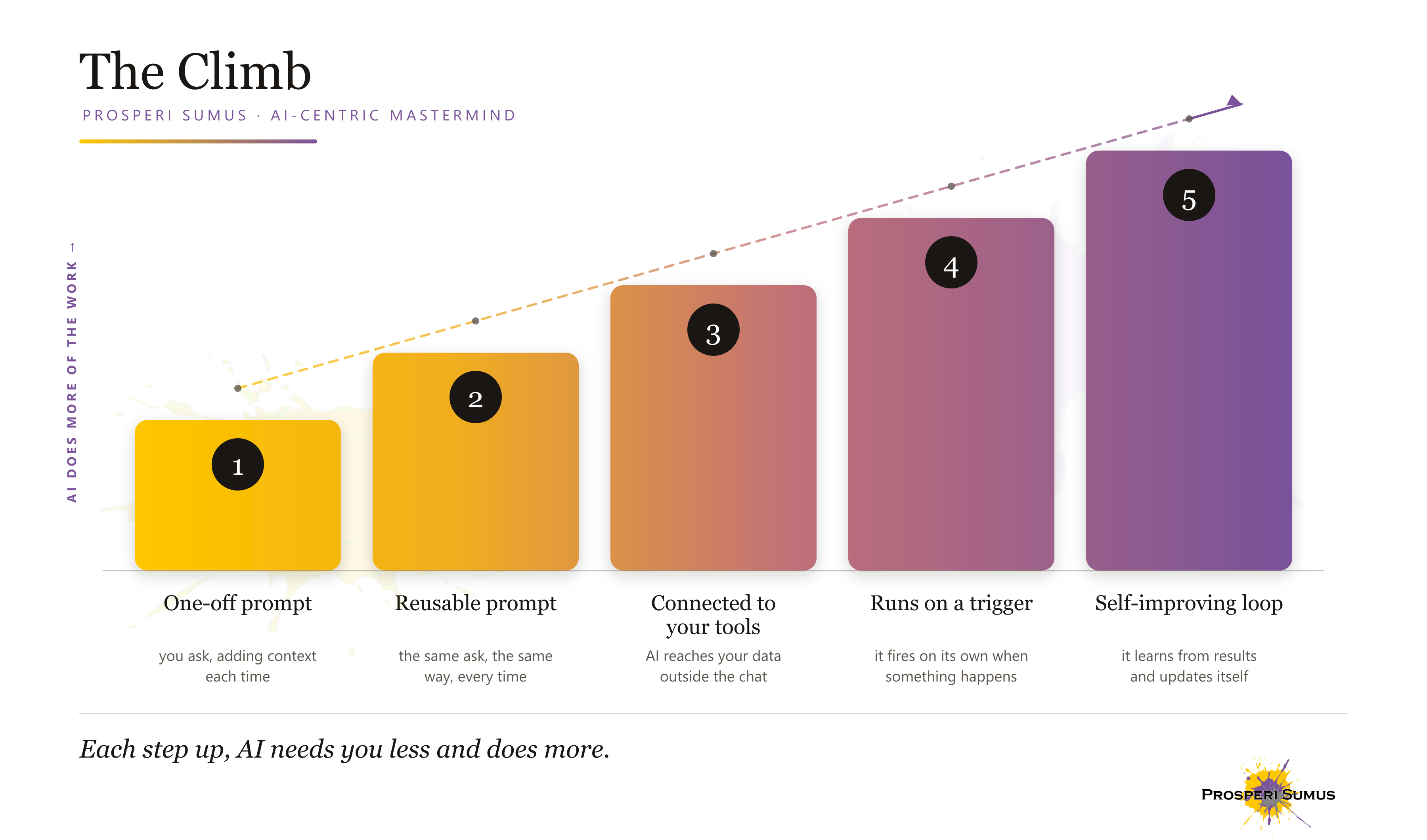
Who keeps the room
worth being in
Jason vets every seat personally. He reads each application himself and turns down people who’d dilute the room — that gatekeeping is the job, and it’s what makes the other eleven seats worth having.
He can hold that bar because he clears it. He’s the founder of IRONCLAD, an underwriting SaaS product he wrote himself, and he runs his own operations on custom internal apps and agent automations he built. In session he’s another operator with his screen shared — building alongside you, not lecturing at you.
You’re here because of who else is in the room.
Angel brings the part most AI rooms are missing entirely: whether you’ll actually do it. She’s a coach and community leader who has spent years working with entrepreneurs on the gap between what they intend and what they execute. When you commit to something in this room, Angel is why that commitment has weight.
Frank is an investor, podcaster, and community builder who has spent his career making rooms work — reading the group, drawing out the person who’s holding back, keeping it honest. He’s the reason this is a room and not twelve people on a call.
Three people who’ve built businesses and run rooms. They convene it, screen it, and keep it honest — but they are not the reason to join. The other people in the room are.
Every two weeks this room asks what you took to production. Here’s my answer — the live map of what my AI actually runs. Read it as a peer, not a fan. See it →
Who this is for
This is genuinely not for everyone, and we mean that as a description of the format rather than a sales line. A room this small only works if every seat is carrying weight.
One screen matters more than all the others: you have to be using AI in your work already. Not curious about it, not planning to start in the new year — actually using it, with something you’ve built or automated to show for it, however rough. This room assumes that on day one and moves from there. If you’re earlier in the journey, the free meetups are the better room for now — Angel hosts Marvelous Mondays at 11:00am CT and Fabulous Fridays at 12:00pm CT, both on Zoom and open to every level — and you’ll be welcome to apply for a later cohort.
This is for you if
- You’ve already built or automated something with AI that you actually use. It doesn’t have to be elegant. It has to be real and running.
- You’re running or building something real — a business, a practice, a portfolio, a firm. It doesn’t have to be big. It has to be actually operating.
- You’re the most advanced person in most rooms you’re in, and you’ve noticed that isn’t helping you anymore.
- You can be told your approach is wrong by four people at once and be glad about it.
- You can hold two hours every other week for six months without renegotiating it in month two.
This isn’t for you if
- You’re new to AI, or still mostly reading about it. This room will move faster than is useful to you — start with Angel’s free meetups instead: Marvelous Mondays, Mondays at 11:00am CT, and Fabulous Fridays, Fridays at 12:00pm CT.
- You’re looking for a course to consume on your own schedule.
- You want to be sold done-for-you automation. Members build alongside each other; nobody builds it for you.
- You’re pre-idea and hoping AI will supply the business.
- You need to try one session before deciding. Closed cohorts don’t work that way.
Applications are open. Cohorts start when the room is full.
Before I ask what you shipped, here’s mine. Every system my AI runs without me — named, dated, and specific enough to argue with. If nothing on that page makes you think “I’d have built that differently,” you’re not ready for this room yet. See the whole operation →
Marvelous Mondays and Fabulous Fridays welcome every level. This room lives in the top two.
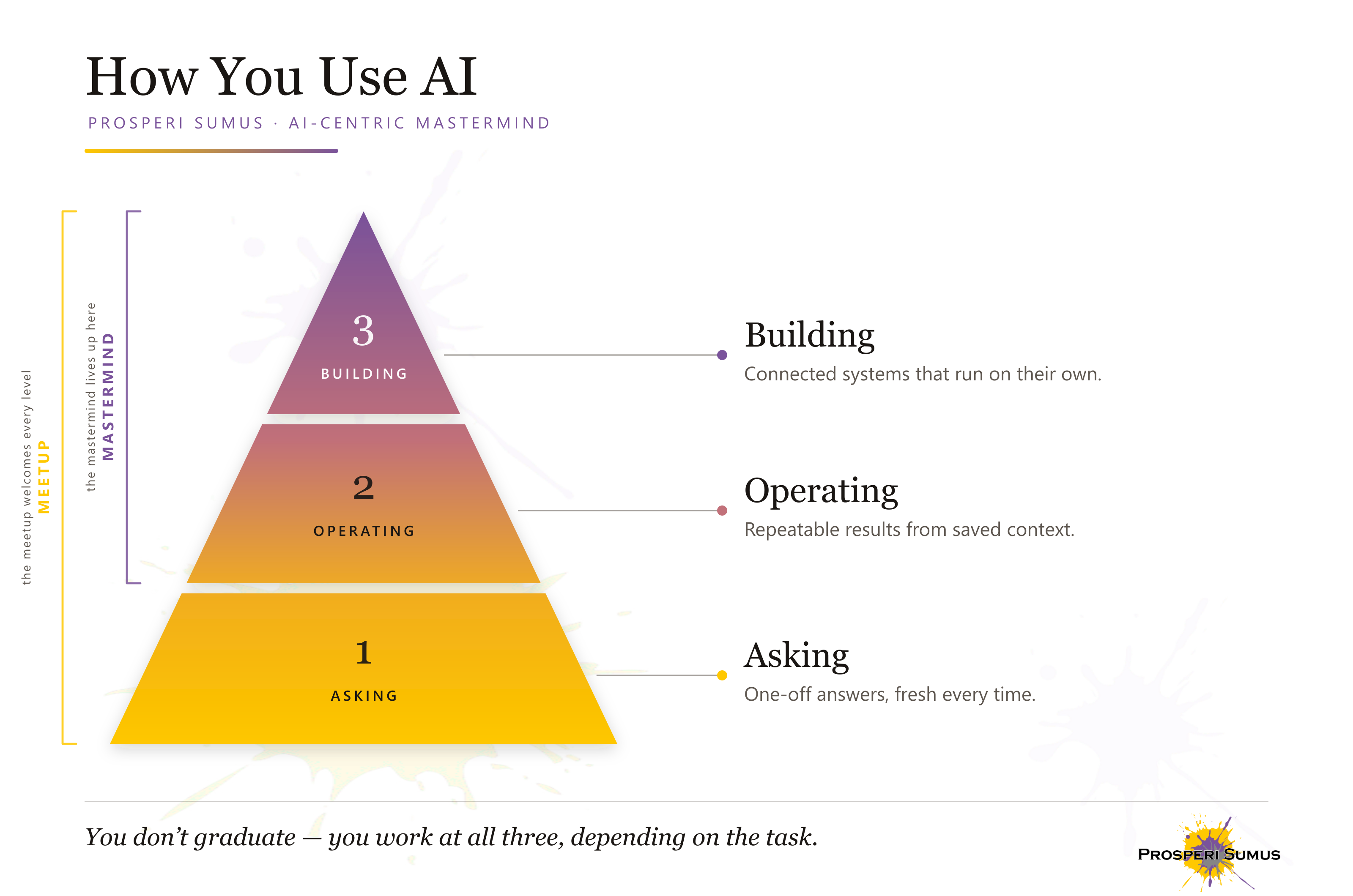
What you’re actually signing up for
Six months. Twelve sessions, every other week. The same room from the first one to the last.
That shape is the commitment. Two hours live every other week, the building you do between them, and a standing expectation that you’ll have something to report when you sit down. Miss the middle of it and the arc doesn’t work — which is why the cohort closes rather than rolls.
If we don’t believe you’d finish, we’ll say so on the call rather than take the seat. An empty chair does this room far less damage than one that goes quiet in month two.
What “in production” actually looks like
This isn’t a promise about your results. It’s a picture of scale — the size of thing one member puts on the board for one two-week cycle. Small enough to actually finish. Real enough that you notice it’s gone from your week.
A proposal that writes its own first draft
Call notes in, a document that’s eighty percent there out. The four-hour version becomes the twenty-minute version.
An inbox that sorts itself
Triaged before you open it, replies drafted for the routine ones, and the three that genuinely need you pulled to the top.
Onboarding that runs without you
The contract gets signed and the sequence fires — welcome, intake, scheduling, the folder, the reminders. You show up to the first real conversation.
A reader for the documents you dread
Statements, reports, leases, contracts — read, with the numbers and terms you care about pulled into one place you can check.
One recording, a month of content
The podcast, the webinar, the client call becomes the posts, the newsletter, the follow-up notes — in your voice, not a robot’s.
The internal tool you were told to hire for
The spreadsheet plus three manual steps plus the thing you keep in your head, replaced by something that just works. This is the size of build the room is for.
None of these require you to write code. All of them require you to decide what’s worth building — and then to be in a room in two weeks where someone asks whether you did.
Before you apply
What if I’m not technical?
That’s fine — most members aren’t, and plenty of what gets built here is assembled from tools rather than programmed.
But “not technical” and “not yet building” are different things. The first is welcome. The second means this isn’t your room yet: everyone here arrives with something they’ve already made, and the sessions start from there rather than from the beginning.
I’m just getting started with AI. Can I join?
Not this room, and we’d rather say that plainly than take your application. Every seat is screened for people who are already building, because the value here comes from the other members — a room where half the people are starting out stops working for the half who aren’t.
Come to one of Angel’s free meetups instead. Marvelous Mondays runs every Monday at 11:00am CT and Fabulous Fridays every Friday at 12:00pm CT, both on Zoom, both open to every level. You register through Angel’s community, The Academy Presents, and the meetups are free. They’re built for exactly this, there’s no application, and people move from there into a later cohort all the time.
What kind of business does this work for?
Any business where a person is doing repetitive work that a system could do. We’ve deliberately kept this out of one industry — a services firm, an investor, an agency owner, and a practitioner in the same room will steal each other’s best ideas precisely because the businesses don’t overlap.
How much time does it take outside the sessions?
Plan on two hours live every other week plus a few hours of building. Members who get the most out of it treat the between-session commitment like a client deadline. Members who get the least treat it like homework.
What if I miss a session?
Sessions are recorded and you’ll have the replay. But this only works if you’re in the room — if you already know you’ll miss more than two of twelve, apply for the next cohort instead.
Which AI tools do you cover?
Whatever is genuinely best when the cohort runs — the major general-purpose assistants for the thinking, the usual automation platforms for the wiring, and custom-built tools when they’re worth the effort.
Nobody sets a syllabus. Members bring what they’re using, the room pressure-tests it, and what gets covered in month five may not exist today — which is roughly the point of a live room over a recorded course.
Can I join partway through?
No. The cohort closes when it starts. If you find us in month two, apply for the next one — we run the waitlist in order.
Is this real-estate specific?
No. Jason, Frank, and Angel come out of real estate and some examples will come from there, but the room is intentionally mixed. The problems are the same everywhere: too much manual work, not enough people.
What happens after I apply?
You’ll hear back within 3 business days. If it looks like a fit, we’ll set up a short call — you’re evaluating us as much as we’re evaluating you. If it isn’t a fit we’ll tell you directly, and tell you why.
Twelve seats, and then
the room closes.
The next six months are going to pass either way. The question is whether you get to the end of them with four or five new things running in your business that don’t need you — or with the same two half-finished builds and still nobody to show them to.
Twelve seats. I read every application myself. Before you write one, look at what I actually run and decide whether you’d hold your own in that room. See it →
Applications are open. Cohorts start when the room is full.
Jason, Frank, and Angel read every application themselves. You’ll get a real answer either way — not an autoresponder — because who gets in is the whole thing.